
Oregon’s Psilocybin Program Is Grounded in Research
The Evidence Behind Oregon’s Psilocybin Program
Oregon’s psilocybin services system did not emerge from cultural enthusiasm or political momentum alone. It was built on a formal review of scientific research commissioned by the state to answer a practical question: where does psilocybin show real, measurable benefit when used in supervised settings?
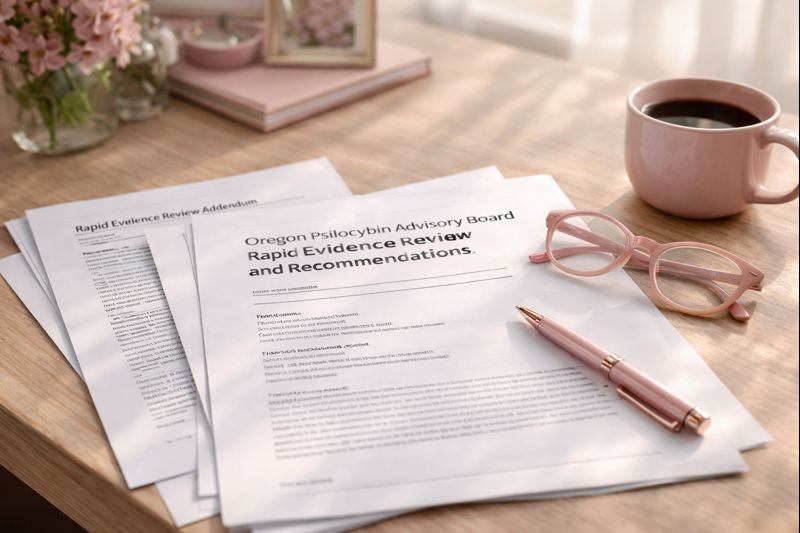
Two public documents form the backbone of that answer. The Oregon Psilocybin Advisory Board Rapid Evidence Review, first published in 2021, examined the strongest available clinical research at the time. In 2025, the state published a Rapid Evidence Review Addendum, adding newer peer-reviewed studies identified by the Products and Research Subcommittee. Together, these documents explain why Oregon moved forward and where the evidence is strongest.
Why Oregon Conducted a Rapid Evidence Review
Measure 109 required Oregon to evaluate safety and efficacy before allowing regulated psilocybin services. Rather than relying on testimonials or advocacy claims, the state asked medical and public-health experts to examine randomized clinical trials, systematic reviews, and long-term follow-up studies.
The result was not a claim that psilocybin treats everything. Instead, the review clearly identified the specific conditions where research repeatedly showed meaningful benefit, and just as importantly, where evidence was limited or still emerging.
Four Conditions With the Strongest Evidence
Across the studies reviewed, four areas consistently showed the most promising and reliable outcomes when psilocybin was used with preparation, supervision, and integration support.
The first is major depressive disorder, including treatment-resistant depression. Multiple trials showed large and sustained reductions in depressive symptoms, sometimes lasting months after one or two supervised sessions.
The second is anxiety and depression associated with life-threatening illness, including end-of-life distress. Studies involving people with advanced cancer demonstrated significant reductions in anxiety, fear of death, and psychological suffering, along with improved quality of life and emotional well-being.
The third is post-traumatic stress and trauma-related symptoms. While fewer large trials exist compared to depression, the review found consistent evidence that psilocybin may reduce trauma-related distress, particularly when trauma is accompanied by depression or existential distress. This is an area the review highlights as both promising and deserving of continued research.
The fourth is substance use disorders, especially alcohol and tobacco use. Clinical trials showed substantial reductions in heavy drinking days and unusually high smoking cessation rates when psilocybin was paired with structured psychological support.
These four areas are not accidental. They reflect where results were most consistent across studies and where supervised use demonstrated both benefit and an acceptable safety profile.
What the Research Also Makes Explicit
The review is careful to emphasize that outcomes depend heavily on context. In nearly every study showing benefit, psilocybin was administered in a controlled setting with medical screening, preparation beforehand, and integration afterward. The research does not support unsupervised or casual use as a substitute for care. Side effects such as fear, nausea, and temporary increases in blood pressure were common, and screening for certain psychiatric and cardiac conditions was essential. Serious adverse events were rare in clinical settings but not absent. This evidence directly shaped Oregon’s emphasis on facilitation, preparation, and post-session support rather than simple access.
Why the Addendum Matters
The 2025 addendum adds newer studies on depression, alcohol use disorder, brain effects, safety data, and long-term outcomes. Importantly, it does not overturn the original conclusions. Instead, it strengthens them and signals that Oregon views the evidence base as evolving rather than fixed. The addendum also acknowledges gaps, including the need for more diverse study populations and continued research into trauma-related conditions.
What This Means for People Considering Psilocybin in Oregon
Oregon’s system was designed around what the research actually supports, not what people wish were true. The focus on depression, trauma-related distress, end-of-life anxiety, and substance use disorders reflects the strongest available evidence at the time the program was built and updated. For anyone considering a psilocybin experience in Oregon, these documents offer transparency and grounding. They explain why the system looks the way it does and why care, screening, and integration are central rather than optional.
For readers who want to explore the source material directly, use the links above. Both reviews are publicly available through the Oregon Health Authority and remain essential reading for understanding the foundations of legal psilocybin services in Oregon.